Friday, May 27, 2011

New Zealand's Murder Parrots

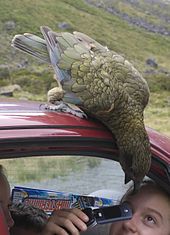
Oceania, as we all know, is home to some striking and unusual life forms. The marsupials in Australia, the Birds of Paradise in New Zealand, and the legions of horribly toxic monsters in every corner of the region. But one animal that stands out among the rich foliage and sheep jokes is the magnificent Kea. One of New Zealand's only parrots, (the other two, the Kaka and Kakapo, are also odd but considerably less interesting,) Kea are olive green in color, with orange splashes on the undersides of their wings and are highly clever, social birds. Their diet includes roots, berries, nuts, seeds, and, incidentally, sheep.

 
A vicious killer on the prowl.
Ever since people settled in the zoological wonderland known as New Zealand, strange things began to happen to their livestock. Sheep would intermittently turn up dead, with gaping wounds on their sides and bellies, despite the fact that the isle lacked any sizable predators. For a while, people were baffled, until they turned their sights on the only plausible culprit: Kea. The Kea had been known to eat plenty of carrion, and to occasionally hunt lizards and smaller birds for meat. They were established omnivores, numerous and wily, and they seemed to be the only viable suspect in the bizarre killings.

Most naturalists dismissed the idea, saying it was impossible for birds, (even 19-inch long birds that travel in packs wielding razor claws and bone-snapping beaks,) to kill healthy sheep. Some conceded that maybe the livestock were dying naturally and the Kea, along with insects and other scavengers, would mutilate them post-mortem. But this theory simply didn't justify why perfectly normal animals were dropping dead out of nowhere: primarily sheep, but also dogs, cats, rabbits and even horses. For decades this remained a hotly debated phenomenon.

It wasn't until 1993 that night vision cameras finally captured one of the deadly assaults. There, in the still of night, came the parrots. Approximately three or four of them descended into the field and hopped menacingly towards their victim. The Kea leapt onto a ewe's back and tore unrelentingly at her hide, her short neck and stumpy limbs leaving her powerless to stop them. The footage revealed that the Kea were actually digging around for the sheep's fat, just underneath her skin, and opened some impressive wounds in doing so. Injured sheep rarely died right away, but would eventually succumb to infection or gradual blood loss. This tape proved that Kea would attack perfectly healthy sheep for food, and it's not unlikely that they prey on other domesticated critters as well. Therefore, Kea are the only parrots in the world known to successfully hunt animals many times their own size.


--OH JESUS CHRIST!

Aww, Polly wanna--

 So there you have it, folks: New Zealand's adorable slaughter parrots. They're intelligent, they're inventive, and they hunger for raw mammalian flesh. How long do you think it'll take before the rest of their avian brethren join forces and decide to go Hitchcock on our flabby, unprotected human asses?  

UPDATE: We now have video of this grizzly phenomenon. Fair warning, it's pretty damn creepy. 

Friday, May 20, 2011

Picidaelicious

To compensate for that monstrous sea cucumber article, I'm keeping this one short and sweet. Woodpecker tongues. They aren't something most people spend time thinking about, but most people aren't reading this hideous blog either.

Thpppppt.

Woodpeckers are specialized drilling machines. Their skulls are heavily reinforced and their tiny brains are insulated against shock. But how do they get at their prey once the hole is finished? What keeps those delectable grubs and termites from crawling away as soon as they notice the giant hungry beak protruding into their nest? The answer: a prehensile, (up to) four or five inch long tongue. Unlike humans, woodpecker's tongues include cartilage and bone, not just muscle, and retract deep into the skull when not in use. They actually wrap around the brain cavity in a complex loop. These dexterous, thread-like apparatus are used to probe about in the cracks of the wood and wrap around prey to suck them back into the mouth. Some are also bristled, like a toilet brush, and most are quite sticky.

[Figure 4 (Diagram of short- (left) and long-tongued (right) woodpecker
skull and hyoid apparatus.)]
...I'm not even going to try to explain this.
So from now on, don't picture vibrant plumage or annoying cartoon laughter when you think of woodpeckers. Think of their tongues. Exceedingly long, flexible nightmare tongues.

Saturday, May 14, 2011

The Majestic Sea Cucumber

Oh echinoderms, where would we be without you? The oceans would probably be starved and barren, sure, but more importantly the world would be a lot less slimy. And we at WTFNature just can't have that.

The fun part about sea cucumbers isn't their sedentary lifestyle, bland eating habits or squishy, featureless bodies. (We already see that in the US suburbs.) To put it simply, no other animal in my conscious knowledge lives an existence that revolves so much around its anus. Most every aspect of life for echinoderms is tied to their bunghole in some way or another. For instance, sea cucumbers have a unique respiratory system that sucks in water through the cloaca, extracts oxygen and then expels water through the same opening, effectively allowing them to 'breathe' through their anus. ...Thankfully, these creatures lack any true brain to recognize the short, sad lives of filtering water from their asses, but this is only one of the aberrations that makes up a sea cucumber's being.

You just can't have an article on sea cucumbers without mentioning the pearlfish. Pearlfish are usually commensalistic feeders, meaning that they take advantage of other animals but neither kill nor harm them. They're a little rougher on our echinoderm friends, though. As juveniles the pearlfish will drift around for a while until they can stop and make themselves comfortable in, you guessed it, the sea cucumber's anus. Peeking in every now and then to collect waste for food and to shield themselves from attack, the pearlfish will also take a nibble off the gonads or cloacal wall any time they get hungry. They are basically the horrible roommates of the animal world; eating your food, breaking your stuff and always showing up late with the rent.

Hey buddy, can I borrow $50 for gas? You know I'm good for it.

Living as a semi-mobile tube of meat comes with its risks, and sea cucumbers are faced by a wide variety of predators such as eels, crabs and humans. Risking life and (metaphorical) limb to venture out into the world and graze the ocean floor, these animals have pioneered a devious mode of self defense. When threatened, sea cucumbers will promptly contract every muscle in their flabby bodies and force a chunk of their respiratory tree, (roughly equivalent to the alveoli and bronchi of vertebrates,) rather violently out of the anus. The slimy, toxic filaments are meant to distract an attacker long enough for the sea cucumber to escape. Due to their regenerative abilities, the loss of some semi-important tissue is preferable to being eaten, and thus a bizarre defense mechanism has proven to be surprisingly effective for the humble but prodigious sea cucumber.

All they want is some respect. And plankton. Lots of plankton.

Not only do they fight and breathe through their anuses, but do keep in mind that sea cucumbers, like many ocean dwellers, have only one cloacal opening and therefore reproduce by this all-purpose orifice as well. In conclusion, as you take in all this strangely horrific information on invertebrate life, please be reminded about the wonder of nature and its intense beauty in many other aspects of the world. Run off to look at some kitten pictures or something in hopes of purging this article from your head. But I would like to add that, for the record, any animal who can disembowel itself on command and live earns its share of respect from me. We salute you, sea cucumbers, for defying our flimsy human logic and nauseating our sensitive constitutions for many a generation to come.

Friday, April 29, 2011

Tasty, Tasty Babies

Most of the freaky things in nature at least have an understandable cause. Female mantises eat their mates so their eggs will have plenty of nutrition. No matter how disturbing, the world's oddities can usually be justified. Infanticide pushes this idea a bit, though.
 
For those of you who don't have the same terrifying vocabulary that I do, infanticide is the practice of killing children. Specifically one's own children. Bears and lions are the worst offenders of the mammal world, often killing the offspring of other males to prevent competition. Whenever a new male lion takes command of a pride, his first order of business is to pick off all the existing cubs, because they're the previous leader's children, not his. Females won't go into heat if they're already taking care of cubs, so his evil plan is essentially to get to mating as soon as possible. Bears aren't even this organized. A male bear will attack any cubs he meets as long as they're vulnerable, even if there's a distinct prospect that they're his own children. To him, all other bears are direct rivals for food and territory. He sees baby killing as a preventative measure, taking care of the problem before they get big enough to be a threat to him. That's why mother bears are so famously protective; leaving their kids alone for too long could mean letting them be murdered for no particular reason.

This isn't a feminist tirade on why females are universally better parents than males, mind you. In the spirit of gender equality, I'd like to make note that there's plenty of infanticidal mommies in the animal kingdom too. There's no birth control in the natural world, and when times are lean, kids are the first liability to go. Stressed rabbits and pigs will turn on their offspring and eat them, taking back some of the precious calories and nutrients they sacrificed on the litter. Fish and insects are less affectionate than that: in many species, the minute you're out of the egg sac is the minute you switch from apple of her eye to, well, dinner. Anyone who's ever kept a tank of guppies will tell you that a good three dozen fry can become eight or nine if the adults get a hold of them, and mum's just as much of a candidate as anyone else.

Chewy.
There's a healthy number of perfectly viable reasons for animals to kill and/or eat their offspring, but somehow that doesn't make squeamish humans feel any better. It's likely something instilled deep in our natures; the same parts of the brain that inspire pigs to, er, 'savage' their litters also drives us to care for our children. All we can do is be mature, let nature run its hideous, grotesque course and thank god every day we weren't born a rodent.

Monday, April 25, 2011

The Charmed Lives of Anglerfish

Our first lesson here at WTF nature will be on the stirring physical specimen known as the anglerfish. Among the many varieties of batfish, football fish, and seadevils, one thing remains the same between all species: one of the most of the most screwed up mating cycles in the vertebrate world. (I'm not bringing spineless wonders into this just yet.) At birth, both sexes are more or less indiscriminate, but the similarity dissolves pretty quickly. Soon the females blossom into the wrinkly, fanged horrors you see in the Discovery Channel photos. The males, however, do not.

These sad, stunted little creatures drift around aimlessly, gaping their tiny mouths at any particles they can snap up. No lure, no gnashing maws, not even much camouflage; they're basically helpless minnows destined to lead brief little lives. That is, unless they can find a female. The relationship between angler genders is less like an egalitarian romance and more like parasitism, you see. ...Exactly like parasitism, really.

Upon meeting a female of his kind, (he can sense her from quite a distance via pheromones,) the male rushes to her side... and burrows into it. He attaches himself to her body, clinging to her with every ounce of his strength until the skin between them begins to disintegrate. Blood vessels mix, reproductive cells are exchanged and before long the male is nothing but a fleshy lump on his mate's hide, having dissolved away into nothing but a pair of gonads. His brain, bones, and G.I. tract all melt away into the female's bloodstream, leaving her with a convenient packet of sperm to be accessed whenever it's time for a new clutch of eggs.

The femme fatale herself.
What's more, this female may mate with many partners over the course of her life, with the same grizzly results each time. She's 100% woman, even if there's two or three pairs of testicles hanging off her backside. The anglerfish have presumably been carrying on with this depraved love life for innumerable generations by now, which leads to a horrific realization: if we've been around for even a fraction of that time, what kind of fascinating reproductive practices might humans develop in the next few million years?

Welcome to WTF Nature!

Nature, as we all know, is a wonderful, mysterious and astounding thing. It's also full of some disturbing shit. This is not a nice, sanitized scientific program you'll see on day time TV; it's blunt, exaggerated, and solely concerned with the grizzly truths behind mother nature's beauty. Like a supermodel without her makeup, you will see the glory of the natural world in all its sociopathic wrongness. So sit back, enjoy, and let the nightmare fuel roll in.