Showing posts with label weird. Show all posts

Wednesday, February 15, 2012

Sweet Transvestite from Sepia Apama

Crossdressing is a tangled and complicated part of human history. It's a practice that's existed as long as we've worn clothes, but it's also a surprisingly common tradition in the animal world. There are plenty of possible reasons for this, from transitions between normal and breeding appearance to outright conditional hermaphroditism. But few creatures are much more... renowned for this interesting behavior than the Australian Giant Cuttlefish.

Hey sailor!
The giant cuttlefish, the largest species of its kind, is a master of camouflage. Its eyes are highly advanced, especially for an invertebrate, and it's capable of changing the color, texture and overall shape of its body on a moment's notice. This species also suffers from a remarkably skewed gender ratio: they have about eleven males hatched for every one female. Consequentially, competition among males is very high, and this rivalry has lead to the development of some peculiar reproductive tactics.

♪ One is the loneliest number that you'll ever do... ♫

In order to monopolize whatever mating opportunities they can get, male cuttlefish become very territorial in spawning season. They'll reign off the biggest chunk of reef they can find and defend it with their lives, driving off any other fellas that dare set tentacle on their turf. So how do the smaller, younger males go looking for love? Simple: they disguise themselves as females. Breeding males will waste no chances to impress the ladies, and are more or less constantly flashing in brilliant, rippling hues with the help of their HD-TV skin cells. Females (and males wanting to impersonate them) maintain their usual subdued, sandy colors, to avoid drawing unnecessary attention from predators.

He might get eaten alive by dolphins, but he's gonna look fabulous doing it.

The smaller males use their girlish figures to sneak into other males' territories and court their females. Just for perspective, the human equivalent of this behavior would be for a reedy guy to walk into a ganglord's hideou dressed in drag and hope for the best. Since giant cuttlefish are polyandrous (females mating with multiple males) this works out pretty well for everyone but the dominant suitor. All he can do is patrol his territory to the full extent of his boneless strength and keep an eye out for any suspicious goings-on in his harem. Like most cephalopods, cuttlefish will die at the end of their breeding cycle: leaving behind a new generation of bruisers, brains and dubious 'females'.

Nope, no menfolk around here. Never seen them. No idea what you're flashing about.

Thursday, August 4, 2011

Butterfly Bachelor Chow

Lonely males, regardless of phylum, are not known for good eating habits. But they do typically stay within the parameters of their species normal diet: bored eels just aren't chowing down on seaweed. Butterflies are an odd exception, though, as we will shortly discuss.

Slob.
Every first grader knows that butterflies and the varieties of moth that do eat all feed by fluttering from flower to flower and drinking nectar. Their larvae feast on a wide range of leaves, like the monarch caterpillars eating toxic milkweed to make themselves unpalatable to predators. However, the adult males of several species will also descend on some... less savory dishes; such as urine puddles, feces, and the carcasses of larger animals. Even though they don't contribute any immediate energy, lapping at these foul sources has an undeniable benefit for these males. They are rich with the minerals, proteins and amino acids that flowers simply can't provide.

But the real significance of this behavior comes out in courtship and mating. When certain butterflies mate, the males will inseminate the female with a packet called a spermatophore. This 'nuptial gift' contains not only the sperm but a dose of vital nutrients, namely the minerals and proteins that they worked so hard to collect. These compounds are imperative for the healthy development of eggs.

Tastes like chicken! ...Well, a certain part of the chicken.

Some females, however, will cheat by mating with multiple males to collect their nuptial gifts, but only producing offspring for the last of the set. Several families have means to combat this, such as a pheromone signature that makes a non-virgin female unattractive to other males, or a mating process that makes it physically impossible for the female to mate twice. Either way, males of many species will do their best to see that their labors of scavenging sweat and other bodily fluids doesn't go to waste.

So remember fellas, having to buy your girlfriend a bouquet or some chocolate every now and then isn't so bad. If you were a spider, you'd probably be eaten by your belle once you'd outlived your usefulness; and if you were a butterfly you'd spend days of your brief life sucking on poop in hopes of having babies that survive infancy.

Saturday, June 11, 2011

Geoduck: Great Mascot, or the Greatest Mascot?

We here at WTFNature are dedicated to sharing informative articles on the wonders of the natural world. Today's feature is a hardy little bivalve known as the geoduck (that's pronounced "gooey duck.") These animals can live over 100 years--


--in fertile saltwater all around the world. Their long siphons are used to peacefully filter debris particles for food and they, unlike most mollusks, are not--


--hermaphroditic but gendered. Breeding for geoducks is very slow and unreliable, as only a small fraction of their eggs are fertilized and an even smaller portion of these live to maturity. Also known as mirugai or long-necked clams, geoduck are used--


--all around the world in a multitude of dishes. They're an obscure but valued ingredient in some French sweetbreads, sliced thin in Japanese sashimi and served many ways in Chinese cuisine, usually as--

--a lovely fondue-style hotpot. Farming and selling geoducks is a major business in the Northern US and Canadian seaboard, mostly in Washington and British Columbia. It takes many years for the animals to mature from tiny bud-like nymphs into edible adults, and they sell for--


--up to $3 US per lb. Evergreen State College of Olympia honors the geoduck as their official school mascot. They earned the position because of the school 's motto, Omnia Extares (or, "let it all hang out,") as a--


--reference to their carefree, sedentary lifestyle. In short, the geoduck is a humble but sadly unappreciated creature that plays an important role in our economy, environment and academic scene. The unofficial motto of our site is 'give credit where it's due,' and today we honor the noble geoduck for its subtle contributions to the world.

Friday, June 3, 2011

Hyena Sexism

What do you first think of when you imagine hyenas? Their cackling voices, their notorious reputation as scavengers, their role as antagonists in every story that mentions them? There's so much about these animals that many don't know, and all the most interesting parts seem to have been omitted from public perspective. Spotted hyenas are highly intelligent creatures who live in a complex hierarchy, and much of their social habits seem to have risen from some strange ultra-feminist text of the sixties.

Negative stereotypes.
You see, spotted hyenas (the most common variety,) have a matriarchal society; meaning that their packs, or clans, are lead by a female alpha. This isn't too unusual in the animal world: bees and ants seem to have run a matriarchal super-empire for eons now, and elephant herds are always guided by the oldest, wisest grandmother in the group. But hyenas stand out because not only does their social structure lean in the womens' favor, their biology actually supports and reinforces this behavior.

Centuries ago, when European explorers first came upon the hyenas, something about their organization seemed strongly amiss. Try as they might, even the best medieval naturalists just couldn't locate a female of their breed. Every hyena they found was stockier and fiercer than the last, and their external sexual anatomy looked... pretty damn masculine. Dark Ages science being what it was, these people soon concluded that there simply were no female hyenas, and that they must be springing up randomly from the earth. (You know, the same way flies suddenly appear out of old meat.) Here's the root of a lot of the stigma surrounding these creatures: ancient "scientists" decided that hyenas weren't born naturally and therefore weren't made by God, but perhaps some unholy supernatural force. The four-legged witches having no way to defend themselves, this assumption hung around for hundreds of years.

This animal's face is on the side of his head. Clearly he's not of this world.

The truth is almost stranger than fiction. -Almost, science couldn't match medieval imagination this time. Obviously, there are female hyenas. I've already made reference to them so they must be real. Ancient scholars just never found them because their anatomy is so misleading. ...As much as we're all wishing to keep this site classy, the explanation here does involve a little bit of hyena gynecology, so skip through to the next section if you're squeamish. When you look at the backside of an adult hyena, (which I know you're all just dying to do,) you'll invariably see what appear to be testicles. Actually, females of the Crocutta genus have large, prominent labia, as well as an overdeveloped clitoris that looks and behaves like a penis. They can get erections and produce large amounts of androgens (male hormones) in their blood, which explains some of the typically 'masculine' behavior. This exotic equipment comes with its setbacks, as infant mortality and miscarriage rates for hyenas are exceedingly high, and about 10% of first-time mothers die in labor.

Scientists are still unsure about why evolution shaped these charming shemales, but it might have something to do with their long gestation periods and high competition for food. Either way, it can be difficult for an observing human to discern the sexes unless you take into account that the females are noticeably larger and more aggressive than the males. (We only figured this out after a few much-needed dissections.) Basically, their society revolves around an inversion of the typical gender dynamic: the females are the big, domineering ones, who make kills while hunting and get first dibs on food. They pick and choose their mates from a list of hopeful males, and a potential suitor will only earn her paw if he expresses total submission to her. Females still take exclusive responsibility for their young, but any male who comes too close to them will be punished severely. They're essentially nature's real-life Amazons, with comparatively small, captive menfolk who they treat like trophies and boy toys.

Get back in the kitchen and make me a sammich!
Before anyone points out some unfortunate implications I might be stirring with the whole 'savage matriarchy' idea, keep in mind that hyenas are proven to be some of the most intelligent carnivores in world. Their society is richly tiered and their communication is much more advanced than that of canines or felines. IQ tests suggest that their social skills are on par with some monkeys in terms of complexity and efficiency, and one experiment even suggested they're better at group problem-solving than chimpanzees. Contrary to popular belief, they hunt just as much as lions do and actually have a higher predatory success rate, which means less carrion and more zebra for dinner. In addition, they don't have any of the infanticidal tendencies of the big cats: the usual cause of neonatal death in hyenas is infighting among litters, especially with same-sex siblings. (You thought our sibling rivalry was rough? Try fighting your twin to the death at two days old.) As I shrilled at you in the beginning, there's a lot of information about animals that isn't common knowledge, and I don't recommend forming your perception of an entire species until you know the facts. Now when you hear about hyenas, maybe you'll imagine their fearsomely effective Amazon brigades instead of those schmucks from "The Lion King."

Friday, May 27, 2011

New Zealand's Murder Parrots

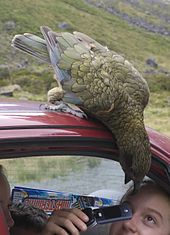
Oceania, as we all know, is home to some striking and unusual life forms. The marsupials in Australia, the Birds of Paradise in New Zealand, and the legions of horribly toxic monsters in every corner of the region. But one animal that stands out among the rich foliage and sheep jokes is the magnificent Kea. One of New Zealand's only parrots, (the other two, the Kaka and Kakapo, are also odd but considerably less interesting,) Kea are olive green in color, with orange splashes on the undersides of their wings and are highly clever, social birds. Their diet includes roots, berries, nuts, seeds, and, incidentally, sheep.

 
A vicious killer on the prowl.
Ever since people settled in the zoological wonderland known as New Zealand, strange things began to happen to their livestock. Sheep would intermittently turn up dead, with gaping wounds on their sides and bellies, despite the fact that the isle lacked any sizable predators. For a while, people were baffled, until they turned their sights on the only plausible culprit: Kea. The Kea had been known to eat plenty of carrion, and to occasionally hunt lizards and smaller birds for meat. They were established omnivores, numerous and wily, and they seemed to be the only viable suspect in the bizarre killings.

Most naturalists dismissed the idea, saying it was impossible for birds, (even 19-inch long birds that travel in packs wielding razor claws and bone-snapping beaks,) to kill healthy sheep. Some conceded that maybe the livestock were dying naturally and the Kea, along with insects and other scavengers, would mutilate them post-mortem. But this theory simply didn't justify why perfectly normal animals were dropping dead out of nowhere: primarily sheep, but also dogs, cats, rabbits and even horses. For decades this remained a hotly debated phenomenon.

It wasn't until 1993 that night vision cameras finally captured one of the deadly assaults. There, in the still of night, came the parrots. Approximately three or four of them descended into the field and hopped menacingly towards their victim. The Kea leapt onto a ewe's back and tore unrelentingly at her hide, her short neck and stumpy limbs leaving her powerless to stop them. The footage revealed that the Kea were actually digging around for the sheep's fat, just underneath her skin, and opened some impressive wounds in doing so. Injured sheep rarely died right away, but would eventually succumb to infection or gradual blood loss. This tape proved that Kea would attack perfectly healthy sheep for food, and it's not unlikely that they prey on other domesticated critters as well. Therefore, Kea are the only parrots in the world known to successfully hunt animals many times their own size.


--OH JESUS CHRIST!

Aww, Polly wanna--

 So there you have it, folks: New Zealand's adorable slaughter parrots. They're intelligent, they're inventive, and they hunger for raw mammalian flesh. How long do you think it'll take before the rest of their avian brethren join forces and decide to go Hitchcock on our flabby, unprotected human asses?  

UPDATE: We now have video of this grizzly phenomenon. Fair warning, it's pretty damn creepy. 

Friday, May 20, 2011

Picidaelicious

To compensate for that monstrous sea cucumber article, I'm keeping this one short and sweet. Woodpecker tongues. They aren't something most people spend time thinking about, but most people aren't reading this hideous blog either.

Thpppppt.

Woodpeckers are specialized drilling machines. Their skulls are heavily reinforced and their tiny brains are insulated against shock. But how do they get at their prey once the hole is finished? What keeps those delectable grubs and termites from crawling away as soon as they notice the giant hungry beak protruding into their nest? The answer: a prehensile, (up to) four or five inch long tongue. Unlike humans, woodpecker's tongues include cartilage and bone, not just muscle, and retract deep into the skull when not in use. They actually wrap around the brain cavity in a complex loop. These dexterous, thread-like apparatus are used to probe about in the cracks of the wood and wrap around prey to suck them back into the mouth. Some are also bristled, like a toilet brush, and most are quite sticky.

[Figure 4 (Diagram of short- (left) and long-tongued (right) woodpecker
skull and hyoid apparatus.)]
...I'm not even going to try to explain this.
So from now on, don't picture vibrant plumage or annoying cartoon laughter when you think of woodpeckers. Think of their tongues. Exceedingly long, flexible nightmare tongues.

Saturday, May 14, 2011

The Majestic Sea Cucumber

Oh echinoderms, where would we be without you? The oceans would probably be starved and barren, sure, but more importantly the world would be a lot less slimy. And we at WTFNature just can't have that.

The fun part about sea cucumbers isn't their sedentary lifestyle, bland eating habits or squishy, featureless bodies. (We already see that in the US suburbs.) To put it simply, no other animal in my conscious knowledge lives an existence that revolves so much around its anus. Most every aspect of life for echinoderms is tied to their bunghole in some way or another. For instance, sea cucumbers have a unique respiratory system that sucks in water through the cloaca, extracts oxygen and then expels water through the same opening, effectively allowing them to 'breathe' through their anus. ...Thankfully, these creatures lack any true brain to recognize the short, sad lives of filtering water from their asses, but this is only one of the aberrations that makes up a sea cucumber's being.

You just can't have an article on sea cucumbers without mentioning the pearlfish. Pearlfish are usually commensalistic feeders, meaning that they take advantage of other animals but neither kill nor harm them. They're a little rougher on our echinoderm friends, though. As juveniles the pearlfish will drift around for a while until they can stop and make themselves comfortable in, you guessed it, the sea cucumber's anus. Peeking in every now and then to collect waste for food and to shield themselves from attack, the pearlfish will also take a nibble off the gonads or cloacal wall any time they get hungry. They are basically the horrible roommates of the animal world; eating your food, breaking your stuff and always showing up late with the rent.

Hey buddy, can I borrow $50 for gas? You know I'm good for it.

Living as a semi-mobile tube of meat comes with its risks, and sea cucumbers are faced by a wide variety of predators such as eels, crabs and humans. Risking life and (metaphorical) limb to venture out into the world and graze the ocean floor, these animals have pioneered a devious mode of self defense. When threatened, sea cucumbers will promptly contract every muscle in their flabby bodies and force a chunk of their respiratory tree, (roughly equivalent to the alveoli and bronchi of vertebrates,) rather violently out of the anus. The slimy, toxic filaments are meant to distract an attacker long enough for the sea cucumber to escape. Due to their regenerative abilities, the loss of some semi-important tissue is preferable to being eaten, and thus a bizarre defense mechanism has proven to be surprisingly effective for the humble but prodigious sea cucumber.

All they want is some respect. And plankton. Lots of plankton.

Not only do they fight and breathe through their anuses, but do keep in mind that sea cucumbers, like many ocean dwellers, have only one cloacal opening and therefore reproduce by this all-purpose orifice as well. In conclusion, as you take in all this strangely horrific information on invertebrate life, please be reminded about the wonder of nature and its intense beauty in many other aspects of the world. Run off to look at some kitten pictures or something in hopes of purging this article from your head. But I would like to add that, for the record, any animal who can disembowel itself on command and live earns its share of respect from me. We salute you, sea cucumbers, for defying our flimsy human logic and nauseating our sensitive constitutions for many a generation to come.

Friday, April 29, 2011

Tasty, Tasty Babies

Most of the freaky things in nature at least have an understandable cause. Female mantises eat their mates so their eggs will have plenty of nutrition. No matter how disturbing, the world's oddities can usually be justified. Infanticide pushes this idea a bit, though.
 
For those of you who don't have the same terrifying vocabulary that I do, infanticide is the practice of killing children. Specifically one's own children. Bears and lions are the worst offenders of the mammal world, often killing the offspring of other males to prevent competition. Whenever a new male lion takes command of a pride, his first order of business is to pick off all the existing cubs, because they're the previous leader's children, not his. Females won't go into heat if they're already taking care of cubs, so his evil plan is essentially to get to mating as soon as possible. Bears aren't even this organized. A male bear will attack any cubs he meets as long as they're vulnerable, even if there's a distinct prospect that they're his own children. To him, all other bears are direct rivals for food and territory. He sees baby killing as a preventative measure, taking care of the problem before they get big enough to be a threat to him. That's why mother bears are so famously protective; leaving their kids alone for too long could mean letting them be murdered for no particular reason.

This isn't a feminist tirade on why females are universally better parents than males, mind you. In the spirit of gender equality, I'd like to make note that there's plenty of infanticidal mommies in the animal kingdom too. There's no birth control in the natural world, and when times are lean, kids are the first liability to go. Stressed rabbits and pigs will turn on their offspring and eat them, taking back some of the precious calories and nutrients they sacrificed on the litter. Fish and insects are less affectionate than that: in many species, the minute you're out of the egg sac is the minute you switch from apple of her eye to, well, dinner. Anyone who's ever kept a tank of guppies will tell you that a good three dozen fry can become eight or nine if the adults get a hold of them, and mum's just as much of a candidate as anyone else.

Chewy.
There's a healthy number of perfectly viable reasons for animals to kill and/or eat their offspring, but somehow that doesn't make squeamish humans feel any better. It's likely something instilled deep in our natures; the same parts of the brain that inspire pigs to, er, 'savage' their litters also drives us to care for our children. All we can do is be mature, let nature run its hideous, grotesque course and thank god every day we weren't born a rodent.

Monday, April 25, 2011

The Charmed Lives of Anglerfish

Our first lesson here at WTF nature will be on the stirring physical specimen known as the anglerfish. Among the many varieties of batfish, football fish, and seadevils, one thing remains the same between all species: one of the most of the most screwed up mating cycles in the vertebrate world. (I'm not bringing spineless wonders into this just yet.) At birth, both sexes are more or less indiscriminate, but the similarity dissolves pretty quickly. Soon the females blossom into the wrinkly, fanged horrors you see in the Discovery Channel photos. The males, however, do not.

These sad, stunted little creatures drift around aimlessly, gaping their tiny mouths at any particles they can snap up. No lure, no gnashing maws, not even much camouflage; they're basically helpless minnows destined to lead brief little lives. That is, unless they can find a female. The relationship between angler genders is less like an egalitarian romance and more like parasitism, you see. ...Exactly like parasitism, really.

Upon meeting a female of his kind, (he can sense her from quite a distance via pheromones,) the male rushes to her side... and burrows into it. He attaches himself to her body, clinging to her with every ounce of his strength until the skin between them begins to disintegrate. Blood vessels mix, reproductive cells are exchanged and before long the male is nothing but a fleshy lump on his mate's hide, having dissolved away into nothing but a pair of gonads. His brain, bones, and G.I. tract all melt away into the female's bloodstream, leaving her with a convenient packet of sperm to be accessed whenever it's time for a new clutch of eggs.

The femme fatale herself.
What's more, this female may mate with many partners over the course of her life, with the same grizzly results each time. She's 100% woman, even if there's two or three pairs of testicles hanging off her backside. The anglerfish have presumably been carrying on with this depraved love life for innumerable generations by now, which leads to a horrific realization: if we've been around for even a fraction of that time, what kind of fascinating reproductive practices might humans develop in the next few million years?